
Avoid fakes: buy genuine anime blind boxes in Sweden
The fastest way to buy authentic anime blind boxes is from an authorized retailer or by ordering a sealed case. This ensures that you receive the full standard set and reduces the risk of counterfeit or tampered display boxes. Current options in the range include One Piece Luffy's Archive of Adventure, Hello Kitty & Friends Snow Globes and Harry Potter Snow Globes.
In short:
- Buying blind boxes from authorized retailers or sealed cases reduces the risk of counterfeits and guarantees complete sets.
- The probability of getting a secret figure is often between 1/72 and 1/144, and multiple purchases are often required to secure a rare item.
- A full display provides a guaranteed set of standard characters, but no guarantee of secrets or chasers, which affects the choice of purchasing method.
- Official blind boxes should display clear licensing information, correct print quality and batch number to avoid piracy.
- When making a complaint, it is important to document damage with photographs and contact the seller as soon as possible to ensure a quick solution.
Table of contents
- What is a blind box anime and how are the series structured?
- Odds and probability: how likely are rares and secrets?
- Single box, display or sealed case: which is right for you?
- How do you recognize an official and authentic blind box?
- Smart budgeting: when to chase and when to buy listed copies?
- Inventory, delivery and return policy for blind box purchases online
- This is what the timeline looks like from order to delivery
- What do you do if your blind box is defective or faulty?
- Selected official blind boxes at Animefigurer
- The publisher's perspective: why authenticity is non-negotiable
- Sources
What is a blind box anime and how are the series structured?
A blind box is a sealed figure package where the contents are unknown until you open it. What sets this format apart from regular figure purchases is the uncertainty. You know which series you are buying from, but not exactly which figure is in your particular box.
Blind box series are usually built up in three layers. First comes the set, i.e. the fixed group of regular characters in a release, usually 6, 8 or 12 unique characters. After that comes the display (also called whole set or inner case), which is the cardboard that stores order from wholesalers and which contains a complete number of boxes, often 10 or 12. At the top is master case, the outer sealed shipping unit that holds multiple displays and that wholesalers and retailers buy in bulk.
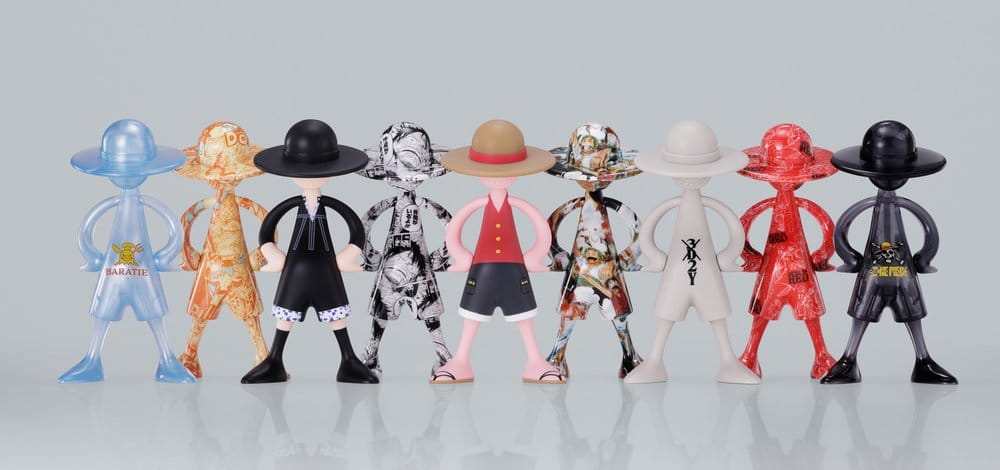
The third element, and the one that drives the whole hobby, is the secret or chaser figure. It is an extra variant that is not part of the standard set and is only found in a fraction of the boxes in a display. Manufacturers almost never publish official pull rates for these figures. This means that all knowledge of odds is based on community data and aggregated unboxing videos, not on the manufacturer's own numbers.
This is what the typical hierarchy looks like in an anime blind box series:
- Standard figures – constitutes the majority of the set, usually a large majority of the draws according to aggregated unboxing data.
- Rarities (rares) – a minor variation or color change of a standard figure, which constitutes a smaller proportion of the draws.
- Secrets/chasers – the rarest variant, often 1–3 % in practice depending on the series.
- Display/whole set – normally contains a guaranteed set of the standard figures but no guarantee of secret.
- Master case – several displays collected, used by traders to fill inventory and by collectors who chase aggressively.
If you understand this structure, you also know why the price differs so much between an individual box and an entire case. You pay for different degrees of predictability.
Odds and probability: how likely are rares and secrets?
The chance of getting a secret in a single box is often between 1/72 and 1/144, according to compiled unboxing data from large community aggregators. These are estimates, not official figures, but they are the best available reference since manufacturers themselves rarely say anything.
Pro tip: Please view all odds listed as a range, not an exact value. Two identical series may have different actual pull rates depending on production run and market.
The statistics behind a case opening
A full 12-box display yields about one secret on average, according to aggregated pull rate data from many documented unboxings. This means that a full display is statistically close to yielding exactly one secret, but there is absolutely no guarantee that comes with the purchase.
So why do some collectors never seem to get a secret even though they buy box after box? The answer lies in the fact that each draw is independent of the previous one. The fact that you didn't get a secret in your last box doesn't affect the odds in the next one. It's the same logic that governs a coin toss: five heads in a row doesn't make heads more likely on the sixth toss. A explanatory review of how blind boxes work shows concretely why ten purchased sets still do not guarantee a secret, despite the fact that many collectors intuitively believe the opposite.
If you want to calculate more precisely, you can use the inclusion-exclusion principle, a mathematical method for calculating the probability of getting at least one specific figure after a certain number of draws. In words: you calculate the probability of NOT getting the figure in a single box, raise it to the power of the number of boxes you plan to buy, and subtract the result from 1. The more boxes, the higher the chance, but the increase is not linear. A detailed mathematical derivation for blind box probabilities describes the formula for those who want to calculate it themselves.
So what does this mean practically for you as a collector?
- At 1/72 odds, you need on average significantly more boxes than 72 to land a secret with high certainty (for example 95 %), because probability does not work like a counter that is “filled up”.
- An odds tool allows you to enter the pull rate and number of boxes to instantly see the probability at different confidence levels, which is significantly more accurate than guessing.
- Full cases do not provide an absolute guarantee of secrecy, but reduce the variance compared to buying loose boxes spread over time.
- The lower the published odds (1/144 compared to 1/72), the greater the gap between expectation and reality at small buying volumes.
Before you invest money in a chaser, always run the numbers on a calculator instead of relying on your gut feeling. It's the difference between taking a chance and investing with your eyes open.
Single box, display or sealed case: which is right for you?
The choice between individual box, display and sealed case is all about what you really want to achieve. Do you want a quick surprise, a complete set or a real chance at chaser? The answer determines which purchasing option is right for your budget.
-
Single box is the lowest stake and is suitable for those who want to test the format, give as a gift or just feel the excitement of opening a box. The disadvantage is clear: high risk of duplicates if you already own several figures in the series, and practically no realistic chance of secret on a single purchase.
-
Display (whole set) Typically, you are guaranteed to have all the standard figures in the set, as a full display contains exactly the number of boxes that correspond to the set size. This is the most cost-effective way to complete a collection without risking duplicates. This advantage is especially apparent if you are collecting an entire series rather than individual characters, as with the 12-piece Hello Kitty & Friends display.
-
Sealed case (master carton) is the right choice if the target is a chaser. With multiple displays in a sealed unit, the cost per box is reduced compared to buying individual copies, and the probability of landing at least one secret increases with the number of boxes. However, the investment is significantly higher initially, and you tie up capital in figures you may need to resell or give away.
Neither path is objectively “best.” A collector who wants to own the entire One Piece set should choose display. A collector specifically hunting for a single rare Luffy variant should instead count on a case based on published odds, not buy single boxes over a long period of time and hope for luck.
How do you recognize an official and authentic blind box?
Counterfeit and tampered blind boxes are common, especially on secondary markets and when purchased from unregulated sellers. Learning the warning signs will protect both your wallet and your collecting pleasure.
Always start with the licensing marking on the packaging. Official anime blind boxes should display clear licensing information, often in the form of a logo or text confirming an agreement with the rights holder (such as Toei Animation for One Piece or Sanrio for Hello Kitty). If this marking is missing altogether, or appears blurry and misspelled, it’s a red flag.
Then, check the quality of the packaging. Official manufacturers use consistent print quality, accurate color reproduction, and clear batch numbers on the box. Counterfeits tend to have slightly skewed printing, incorrect font for the text, or no batch tracking at all.
Here are the key checkpoints before you pay:
- Make sure the license logo and rights holder's name are clearly visible on the packaging.
- Ask for the original invoice or supplier documentation, especially for larger purchases of entire cases.
- Compare the batch number on the box with what the seller states in their advertisement or product description.
- Investigate whether the seller can show stock photos or video of unopened cases, not just stock images.
- Be extra vigilant when prices are clearly below the market average, this is often the first sign of piracy.
A more controversial method that is used in collecting circles is to weigh boxes to guess the contents, as some figures differ marginally in weight. The method is not entirely reliable and is considered by many sellers to be unethical because it undermines the purpose of the blind box format. If you buy from a retailer, you should instead expect transparency about purchasing policies and authenticity guarantees, not circumvention techniques.
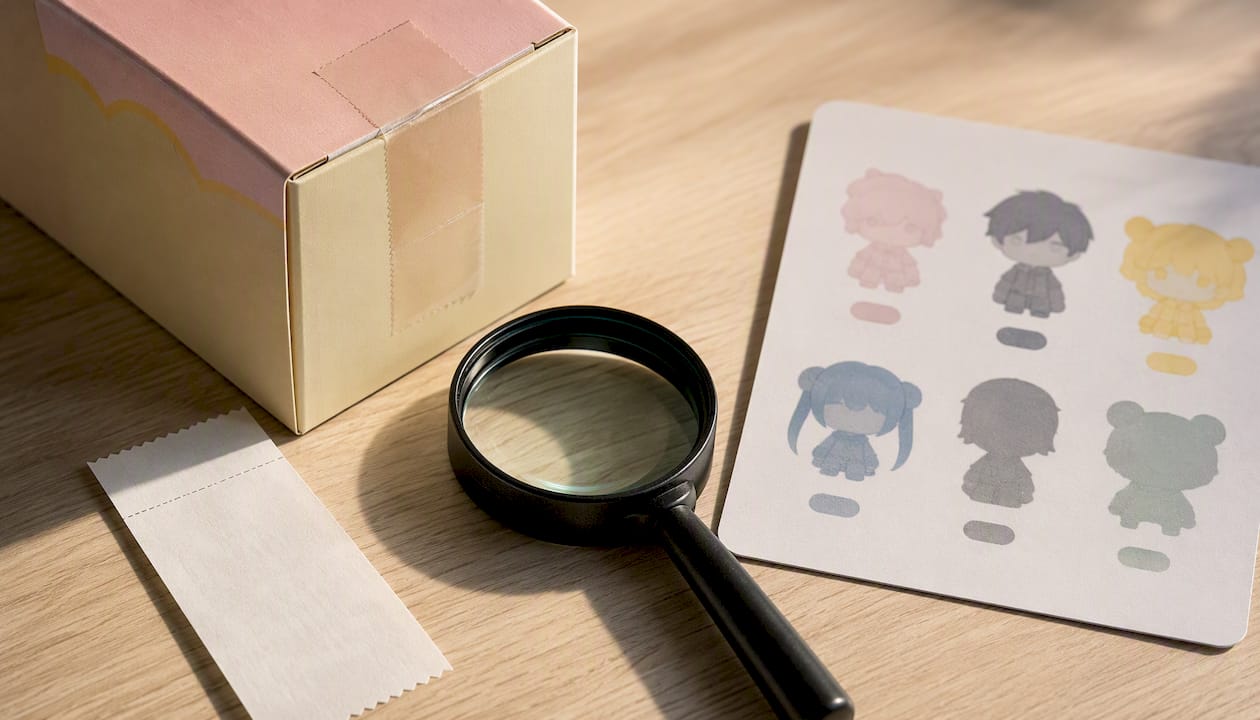
Pro tip: Always keep the original packaging and receipt at least until you have verified the contents against an official visual reference sheet for the series. This will make any dispute over authenticity much easier to resolve.
Smart budgeting: when to chase and when to buy listed copies?
Calculating the cost per chaser before you buy a case will save you from disappointment. If a display costs a certain amount and contains 12 boxes, while the chaser odds are around 1/72 to 1/144 according to aggregated pull data, you can quickly see that multiple cases are usually required to achieve a reasonable chance. Always compare the total cost of the number of cases the math requires with the price of an already unpacked copy from a second-hand seller. It is often cheaper, and guaranteed, to buy the specific figure outright.
Risk management is about being honest with yourself about why you're buying. Are you collecting for the joy of owning the entire series, or are you trying to make a financial profit by reselling rare figures? The two goals require completely different strategies.
- If the goal is a complete collection: buy displays or individual boxes for the standard figures, and consider a listed copy for specifically the secret you are missing.
- If the goal is to chase a specific chaser: calculate the cost per case versus the price on the secondary market before you decide, and use an odds calculator to see how many boxes a certain confidence level actually requires.
- If the goal is resale: diversify across several smaller purchases rather than betting everything on a single case, as the variance in outcome will otherwise be too high.
- Don't forget to include shipping, any customs duties and package insurance in your total calculation, especially for international orders of entire cases.
One final note about budget: return options affect your actual risk. If a seller offers clear returns for shipping damage but not for “wrong” content (which is standard since the content is random), you know exactly what financial exposure you’re taking on before you click buy.
Inventory, delivery and return policy for blind box purchases online
Delivery times often differ between individual boxes and entire displays or cases. A single box can typically be shipped directly from the warehouse shelf, while a full display or master case sometimes requires longer handling time as larger volumes must be picked and inspected before shipment.
The return policy for blind boxes is an area where collectors often get confused. An opened box cannot usually be returned on the grounds that you received the “wrong” figure, since the whole point of the format is that the contents are random. This is the case in practice with most reputable retailers. However, what is normally considered a valid reason for return or complaint is damage in transit, a broken figure upon arrival, the wrong product compared to what was ordered, or a packaging that has arrived obviously tampered with.
Before you shop, always check:
- If stock status is clearly displayed separately for single box, display and case.
- If the delivery time is stated specifically for the type of product you are ordering, not just a general range.
- If the return policy distinguishes between shipping damage and dissatisfaction with random content.
- If the seller offers trackable shipping, which makes it easier to prove delivery status in the event of a dispute.
Shop where these terms and conditions are clearly stated before you buy. A clear set of rules protects you as much as the seller, and it is one of the strongest signs of a serious player in the blind box industry.
This is what the timeline looks like from order to delivery
A typical order for a single blind box normally goes from order confirmation to packaging within a few working days, provided the product is in stock. Displays and entire cases often take slightly longer as the volume requires extra checking that all boxes in the set are sealed and undamaged before being shipped.
Once the package leaves the warehouse, the shipping method determines the rest of the timeline. Domestic deliveries within the same market are typically the fastest, while international orders of full cases may take additional days for customs clearance depending on the destination country. Trackable shipping is especially valuable for more expensive case purchases, as it allows you to follow the package throughout the chain and quickly identify whether a delay is due to the carrier or the seller.
A common pattern among collectors is to pre-order for new series releases. This further shifts the timeline, as delivery only occurs once the manufacturer has released the item to the retailer, not at the time of ordering. Be aware of any estimated delivery window specifically listed for pre-orders, as this often differs significantly from in-stock products that ship immediately.
Always allow for margin when planning a gift around a specific anime blind box, especially if the product comes from an international licensed limited edition series.
What do you do if your blind box is defective or faulty?
Broken figures, spilled packaging material or a box that arrived obviously opened and then sealed can happen, even at reputable retailers. The important thing is how quickly and correctly you act when it happens.
Always take photos of the product and packaging immediately upon unpacking, before throwing away any packaging. Photos of any shipping damage, of the seal and of the batch number on the box are the documentation that customer service needs to quickly approve a complaint. Contact the seller as soon as possible, most retailers set a time limit for complaints, often within a few days to a couple of weeks after receiving the delivery.
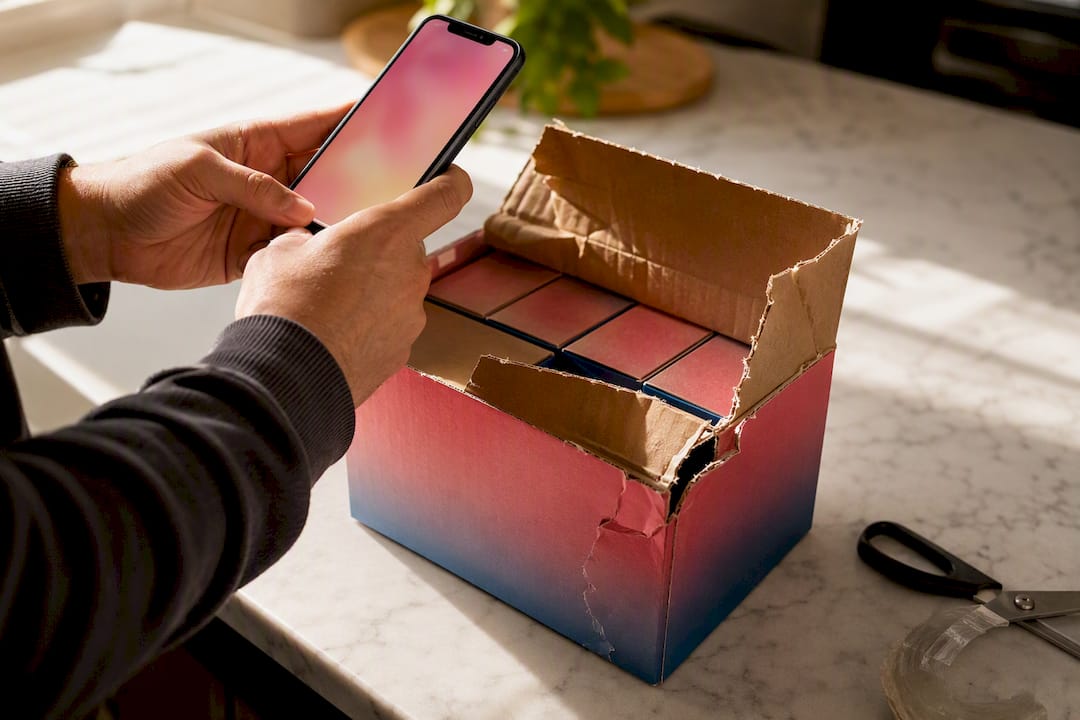
Be specific in your report. Describe exactly what is wrong: is the figure damaged, missing parts, or does the content not match what the packaging indicates as possible alternatives in the series? A clear and factual description, along with visual evidence, makes the process much faster than a vague report that “something is wrong.”.
If the seller does not respond within a reasonable time, escalate through the payment provider or relevant consumer authority in your market. Keep all communication in writing, this will give you a traceable basis if the case drags on. If you buy from a retailer with a clear complaints process from the start, you will in most cases not have to go that far.
Selected official blind boxes at Animefigurer
Anime Figures differs from taking chances with unknown sellers in that each product carries clear licensing markings directly on the product page, with fast delivery and secure payment as standard rather than exception.
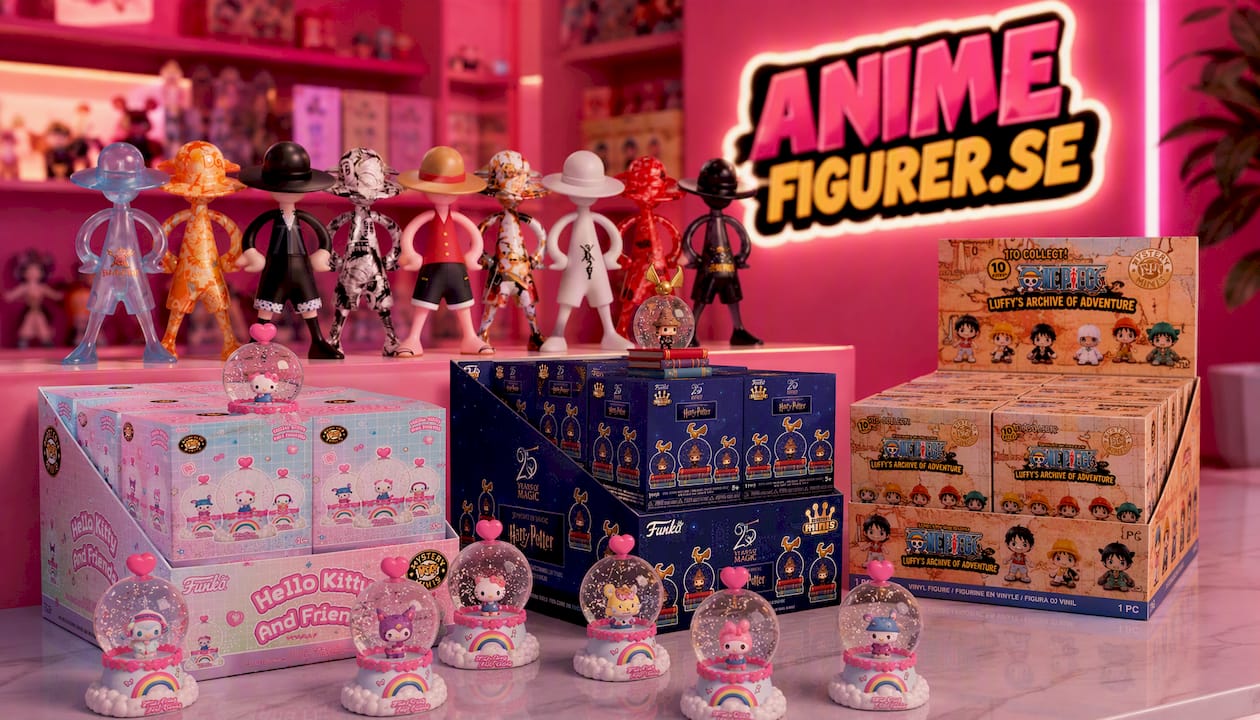
Three options in the range cover different collector needs right now. One Piece Luffy's Archive of Adventure is a ten-piece blind box set, a natural first choice for those who collect Luffy and the crew and want to get close to a complete set without taking a chance on figure by figure. Hello Kitty & Friends Mystery Minis Snow Globes, a twelve-piece display in snow globe format, suits both collectors who want to own the entire series and those looking for a unique gift. Harry Potter Mystery Minis Snow Globes follows the same twelve-piece display model and is aimed at collectors within the Harry Potter universe who want to secure the entire figure series in one purchase instead of hunting down individual boxes over time.
Want to see the full range of official figures and upcoming blind box releases?, visit Anime characters and browse over 300 series. Are you looking for affordable purchases right now? sale page often worth a visit before you decide on a display or case.
The publisher's perspective: why authenticity is non-negotiable
The most common misconception among new collectors is that odds are something you can “cheat” by buying smartly or at the right time. That’s not true. Each box is, as the math shows, a completely independent outcome. What you can actually control is not luck, but the risk around the ticket: where you buy, whether the packaging is authentic, and whether you have a clear return path if something goes wrong.
It's also where most disappointments in the hobby actually occur, not in missing a secret, but in discovering afterwards that the box was never genuine in the first place. A counterfeit blind box by definition lacks accurate odds, as the entire basis for the series is then unknown. Anime figures build their range around licensed products with traceable delivery precisely so that that risk disappears completely before you ever open the box.
My recommendation to every collector, regardless of budget: put as much care into verifying the seller as you do into calculating the odds. You can always check the math yourself with a calculator. You can only trust authenticity if the source is correct from the start.
— Theo
Sources
If you want to simulate your own scenarios before your next case purchase, there are two resources worth bookmarking. Everytoys' odds calculator lets you input pull rate and number of boxes to see probabilities at different confidence levels, while the Math Stack Exchange thread on blind box probabilities provides the underlying mathematical logic if you want to understand why the formula works, not just that it does. Combined with the aggregated pull rate figures for 2026, you have a more solid foundation than guessing based on gut feelings or occasional unboxing videos.
- What Are Blind Box Pull Rates in 2026? The Complete Rarity & Odds Guide for Collectors | Popboxss
- How blind boxes work (and why 10 sets still won't get you the secret) | everytoys
- Math